

A Waymo accident is not always handled like a traditional car crash. When a self-driving vehicle is involved, the questions get harder fast: Was a human in control? Did the software make the wrong call? Who actually owned and insured the car? What does the vehicle’s own data say happened?
These claims sit at the intersection of personal injury law, product liability, and emerging technology. The companies behind autonomous vehicles have technical experts, in-house counsel, and access to data that the average person will never see without a lawyer fighting for it.
If you were hit by a Waymo, injured as a passenger inside one, or struck by another autonomous vehicle anywhere in Florida, Echevarria Legal can help you understand your options, preserve critical evidence, and build a claim that takes the technology seriously.
Talk to a Miami Waymo accident lawyer. Free, confidential consultation.
Waymo is the autonomous vehicle company owned by Alphabet, Google’s parent company. Its vehicles operate as a robotaxi service — riders hail a self-driving car through an app, the car arrives without a human driver, and the trip is completed by the vehicle’s onboard computer system rather than a person behind the wheel.
To navigate the road, a Waymo vehicle relies on a combination of:
This is meaningfully different from systems like Tesla Autopilot or traditional driver-assist features (lane keeping, automatic emergency braking, adaptive cruise control). Those systems are designed to assist a human driver, and the human is legally responsible for the vehicle. A Waymo robotaxi is designed to operate without a human driver at all, which shifts the legal analysis.
Waymo has expanded its service into multiple U.S. metro areas and continues to add new regions. As that footprint grows, more crashes — and more injury claims — are inevitable.
In a typical car accident, the analysis is relatively straightforward: who was driving, what did they do wrong, and what does their insurance cover. A Waymo crash breaks that simple structure in several ways.
If the vehicle was operating fully autonomously, there is no human at the wheel whose negligence caused the crash. The conduct in question is the conduct of the software, the sensors, and the company that built and deployed them.
A single Waymo crash can implicate the company itself, the manufacturer of the vehicle, hardware suppliers, mapping data providers, remote support operators, and other drivers on the road. Working out who is on the hook — and in what proportion — requires investigation, not assumption.
In a normal crash, you have skid marks, witness statements, and maybe a dashcam clip. A Waymo vehicle is, in effect, a continuously recording sensor platform. It has logs of what its cameras saw, what its LiDAR detected, what its software decided, and what commands it sent to the brakes and steering. That data lives on Waymo’s servers, not yours.
Waymo and its parent company have legal, technical, and PR teams ready to respond to incidents. They control the vehicle, the data, and the narrative in the early hours after a crash. Without quick legal action, an injured person can be at a serious disadvantage by the time they think to call a lawyer.
The software running a Waymo vehicle is updated over the air. The version of the system driving the car the day of your crash may not be the version on the road a week later. Capturing the exact software state at the time of the crash matters.
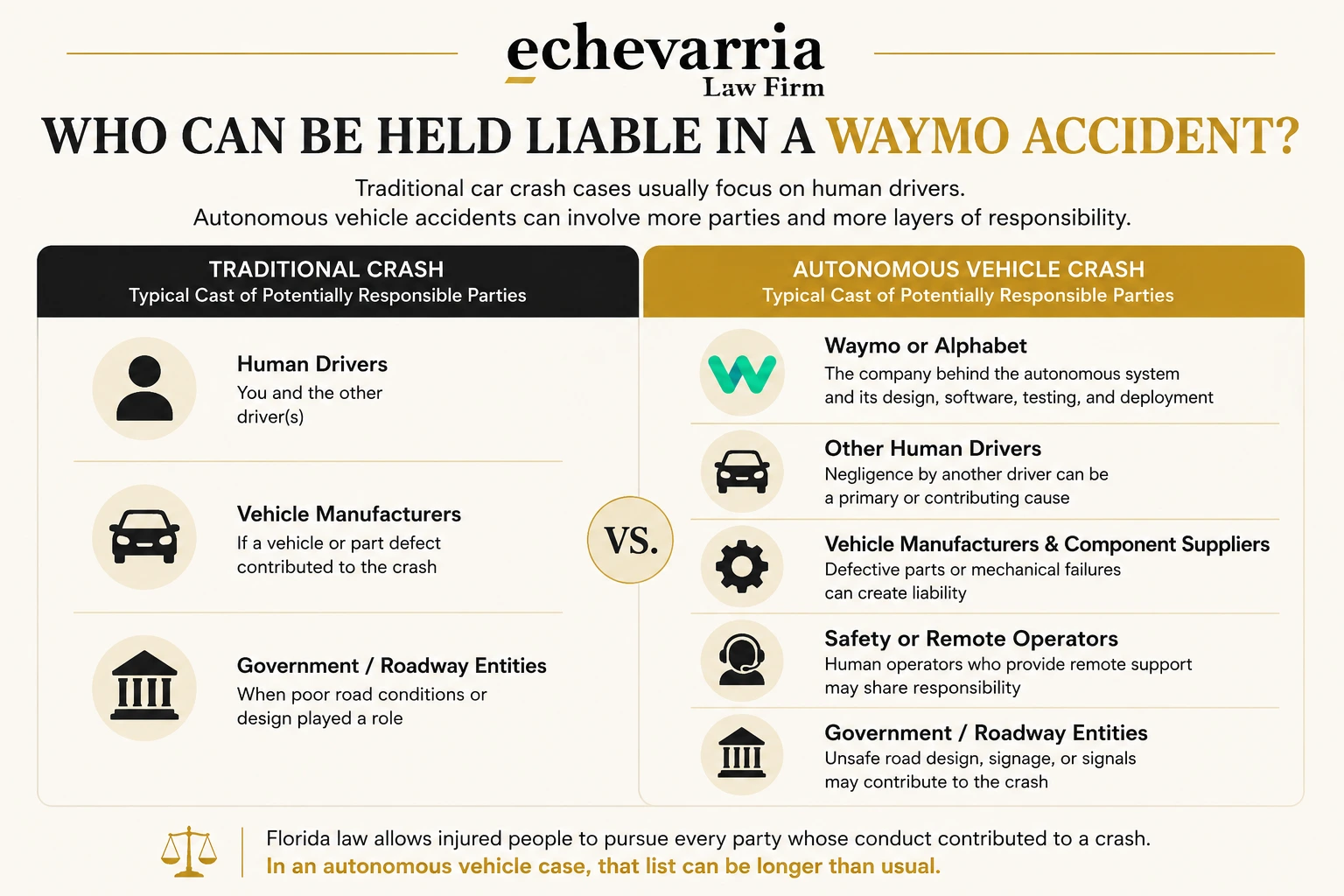
Florida law allows injured people to pursue every party whose conduct contributed to a crash. In an autonomous vehicle case, that list can be longer than usual.
The company that designed, built, tested, and deployed the autonomous system can be held responsible when the system itself fails. Potential theories include:
Many Waymo crashes involve a second vehicle driven by a person. That driver’s negligence — speeding, running a red light, distracted driving — can be a primary or contributing cause, and Florida’s comparative negligence rules will allocate fault among everyone involved.
A Waymo robotaxi is still a physical car. If the brakes, steering, tires, or another mechanical component failed, the manufacturer of the vehicle or the specific part may have product liability exposure independent of the autonomous system.
Waymo’s system includes the ability for human operators to provide remote guidance or support. If an operator gave incorrect instructions, missed a flagged situation, or otherwise contributed to a crash, that conduct can be a basis for liability.
Confusing signage, malfunctioning traffic signals, poorly designed intersections, and unmarked construction zones can play a role in any crash. Where a public entity’s negligence contributed to the crash, Florida law has specific procedures and deadlines for those claims that must be followed strictly.
Autonomous vehicles are designed to outperform humans in many scenarios, but they have characteristic weaknesses. Reported crashes and incidents involving Waymo and other AV systems have included:
The injuries seen in Waymo and other autonomous vehicle crashes mirror those of any serious motor vehicle accident, but the circumstances often have their own pattern. Sudden, computer-initiated braking, unexpected maneuvers, and dense urban robotaxi environments can produce:
Symptoms of brain and spinal injuries are not always obvious in the hours after a crash. Anyone involved in a Waymo accident should be evaluated by a medical provider quickly, even if they feel “fine.” Documentation of those early visits is also important for the legal claim.
Autonomous vehicle cases live or die on evidence preservation. Some of the most important proof never lands in a paper file — it lives on company servers and personal devices that can be wiped, overwritten, or “routinely” deleted within days or weeks. The categories worth pursuing typically include:
Many corporate data systems overwrite logs on a rolling basis unless they are placed under a litigation hold. A formal preservation letter sent to Waymo, the vehicle owner, and other relevant parties shortly after the crash is one of the most important steps a lawyer can take. Once that letter is on file, those parties have a legal obligation to retain the data — and the failure to do so can have serious consequences in court.
Surveillance footage from a nearby gas station or restaurant can be even more time-sensitive. Many systems overwrite within 7–30 days. Identifying and requesting that footage early is often the difference between a clear case and a credibility fight.
Talk to a Miami Waymo accident lawyer. Free, confidential consultation.
In the chaotic minutes and hours after a crash, what you do can shape your case for years. If you are physically able, the following steps protect both your health and your claim:
Yes, in the right circumstances. Lawsuits against Waymo (or any autonomous vehicle company) typically rely on one or more of the following theories:
The same basic theory that applies in any car crash — Waymo, through its system, owed a duty of reasonable care to other road users and breached that duty in a way that caused injury.
If the vehicle, its software, or a component had a design defect, manufacturing defect, or failure to warn that caused the crash, product liability law allows recovery against the company that put the product into the stream of commerce. This is one of the most powerful theories in autonomous vehicle litigation because it does not require proving the company was “careless” — only that the product itself was unreasonably dangerous.
When a Waymo crash kills someone, Florida’s Wrongful Death Act allows the surviving spouse, children, and certain other family members to recover for their losses. These cases have specific rules about who can file, what damages are available, and how proceeds are distributed.
Software is increasingly treated by courts as a “product” for liability purposes. When the autonomous driving system itself behaves in a way no reasonable driver would, that is a software defect — and it can be the central issue in the case.
Florida uses a modified comparative negligence rule. An injured person’s recovery is reduced by their own percentage of fault, and recovery is barred if they are found more than 50% at fault. In a Waymo case, the question of how to allocate fault among the autonomous system, other drivers, and (sometimes) the injured person is one of the most fiercely litigated issues.
Realistically, autonomous vehicle litigation also involves corporate legal teams, technical experts, accident reconstructionists, and digital forensic specialists on both sides. These cases reward preparation, not improvisation.
Insurance coverage in a Waymo crash rarely looks like a typical two-driver accident. There are usually multiple policies stacked on top of each other, and which one pays — and how much — depends on facts most people will not have at their fingertips.
Florida’s no-fault insurance system, the strict 14-day rule for initial PIP medical treatment, and the way comparative fault is argued in settlement negotiations all change how a Waymo claim should be handled. Generic “rideshare claim” advice is not enough.
A traditional car accident investigation might involve a police report, a few photos, and an insurance adjuster’s walk-around. An autonomous vehicle case typically requires more:
This level of work is not theoretical. It is the standard a serious autonomous vehicle case demands, and it is the reason these claims should not be handled with the same playbook as a fender-bender.
The categories of damages available in a Waymo accident case track Florida personal injury law, but the dollar values can be significant given the severity of injuries common in these cases. Available compensation may include:
Autonomous vehicle cases are not the place for a generic car accident practice. They are complex litigation matters involving large corporate defendants, technical evidence, and unsettled areas of law. Echevarria Legal approaches these claims accordingly:
If you or a family member was hurt in a Waymo accident, in another self-driving vehicle, or as a pedestrian or cyclist struck by an autonomous car, Echevarria Legal will sit down with you, walk through what happened, and explain the realistic options.
Talk to a Miami Waymo accident lawyer. Free, confidential consultation.
Yes, in the right circumstances. Injured people can pursue Waymo (and its parent company Alphabet) under negligence, product liability, and software defect theories when the vehicle’s system or the company’s conduct contributed to a crash. Whether a lawsuit is the right path in your specific case depends on the facts, the evidence, and Florida’s comparative negligence rules.
It depends on what caused the crash. Possibilities include Waymo itself (for software, sensor, or mapping failures), other human drivers, the vehicle manufacturer or component suppliers, remote support operators, and in some cases public entities responsible for unsafe roadway conditions. A serious investigation usually identifies more than one potentially responsible party.
Autonomous vehicle companies publish safety data suggesting their systems perform better than the average human driver in some categories. Independent researchers and regulators have raised questions about how those numbers are measured. The honest answer is that the technology has real strengths, real weaknesses, and a still-developing safety record — which is exactly why crashes still happen and still need to be investigated carefully.
The most important evidence usually includes the vehicle’s onboard camera footage, LiDAR and radar logs, autonomous driving event logs, event data recorder (“black box”) data, ride records from the Waymo app, software version and update history, surveillance footage from nearby businesses, eyewitness statements, and the official police crash report. Much of this evidence can be lost if it is not formally preserved quickly.
A pedestrian struck by a Waymo can pursue an injury claim against the company and any other party whose conduct contributed to the crash. Florida law also lets the pedestrian look to their own auto insurance for PIP medical coverage in many situations, even though they were on foot. Pedestrian cases tend to involve serious injuries and benefit from early legal involvement.
Florida has been one of the more permissive states for autonomous vehicle testing and deployment, but the underlying rules for personal injury claims still apply: negligence, product liability, comparative fault, no-fault PIP, and the statute of limitations all govern these cases. What differs is the cast of potentially liable parties and the kinds of evidence that matter.
That is common. Many Waymo crashes involve a second human-driven vehicle whose driver bears most or all of the fault. In those cases, the claim primarily targets the at-fault driver and their insurance, but it is still worth investigating the Waymo vehicle’s data — it often provides the clearest objective record of what actually happened.
Florida’s statute of limitations for most negligence-based personal injury claims is currently two years from the date of the crash, with shorter notice deadlines for claims involving public entities and specific deadlines for PIP benefits. Wrongful death claims have their own two-year deadline. Because deadlines and exceptions can change and depend on the type of claim, you should not rely on a general answer — confirm the deadline that applies to your case with a lawyer as early as possible.
Get medical attention right away, screenshot the trip and any in-app information before it disappears, save any communications with Waymo support, take photos of the vehicle and the scene if you safely can, and avoid giving a recorded statement to the company or any insurer before talking with your own lawyer. Riders inside an autonomous vehicle have meaningful legal protections that are easier to enforce when the early evidence is preserved.
Yes. Software is increasingly treated as a “product” for liability purposes, and a self-driving system that makes an unreasonable decision — for example, failing to recognize a pedestrian, misreading a traffic signal, or executing a maneuver no reasonable driver would — can be the basis for a product liability claim against the company that designed and deployed it.
WhatsApp us for an instant reply