

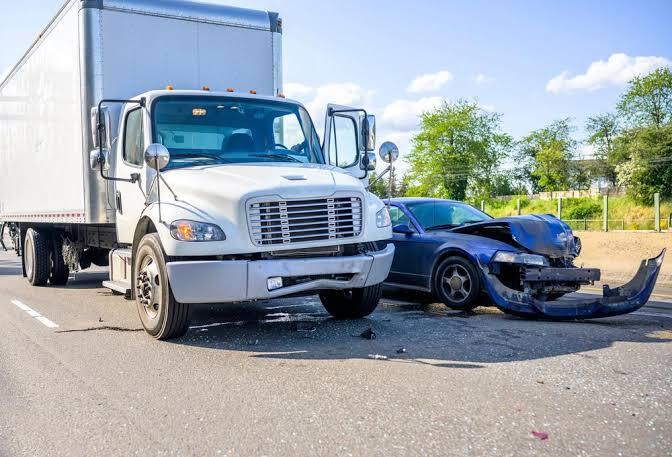
Commercial truck accidents are often far more complicated than collisions involving passenger vehicles. While many people assume the truck driver is automatically responsible, liability in these cases frequently extends beyond the person behind the wheel.
A commercial truck is part of a much larger operation involving trucking companies, maintenance providers, cargo loaders, manufacturers, and strict federal safety regulations. If any one of these parties fails to meet its legal responsibilities, the consequences can be devastating.
If you’ve been searching “who is liable in a truck accident,” the answer depends on the specific facts of the crash, the evidence available, and whether multiple parties contributed to what happened.
For accident victims in Florida, identifying every responsible party is critical because it can affect both liability and the compensation available for medical expenses, lost wages, pain and suffering, and other damages.
This guide explains who may be liable after a truck accident, why trucking claims involve more defendants than ordinary car crashes, how federal trucking regulations influence these cases, and why preserving evidence quickly is often essential.
Why Truck Accident Liability Is Different
Unlike most passenger vehicle collisions, commercial trucking accidents rarely involve only two drivers.
A trucking company may own the tractor.
Another company may own the trailer.
A third business may have loaded the cargo.
Maintenance may have been outsourced.
Certain vehicle components may have been manufactured by another company altogether.
Each party has separate legal duties, and determining whether those duties were breached requires a thorough investigation.
Instead of asking only, “Who caused the crash?” investigators often ask:
- Who owned the truck?
- Who employed the driver?
- Who maintained the vehicle?
- Who loaded the cargo?
- Were federal safety regulations followed?
- Did mechanical failure contribute?
- Were company policies unsafe?
The answers often determine who may ultimately be responsible.
Who Can Be Liable in a Truck Accident?
Truck accident liability often involves multiple individuals and businesses.
The Truck Driver
Truck drivers owe a duty to operate their vehicles safely and follow both Florida traffic laws and federal commercial trucking regulations.
A driver may be liable if the accident resulted from:
- Speeding
- Distracted driving
- Texting while driving
- Driving under the influence
- Fatigued driving
- Following too closely
- Unsafe lane changes
- Running red lights or stop signs
- Failing to account for weather conditions
- Aggressive driving
Commercial trucks require significantly longer stopping distances than passenger vehicles. Even a momentary lapse in judgment can have catastrophic consequences.
However, driver negligence is often only one part of the investigation.
The Trucking Company
Many truck accident claims involve potential liability on the part of the trucking company itself.
Federal and state laws require trucking companies to operate safely and supervise their commercial drivers appropriately.
Potential issues include:
- Negligent hiring
- Inadequate driver screening
- Failure to conduct background checks
- Poor driver training
- Inadequate supervision
- Encouraging unrealistic delivery schedules
- Pressuring drivers to violate Hours of Service rules
- Failure to monitor safety violations
- Ignoring prior accident history
A company may also be responsible for the actions of its employees under certain legal principles when drivers are acting within the scope of their employment.
The Cargo Loading Company
Improperly loaded cargo can dramatically affect how a truck handles on the road.
Problems may include:
- Uneven weight distribution
- Overloaded trailers
- Improper securement
- Cargo shifts
- Falling cargo
- Incorrect weight calculations
A shifted load may increase the risk of:
- Jackknife accidents
- Rollovers
- Loss of steering control
- Tire blowouts
- Trailer instability
If improper loading contributed to the collision, the company responsible for loading the freight may share liability.
Maintenance and Repair Contractors
Commercial trucks accumulate thousands of miles every month.
Routine inspections and maintenance are essential for safe operation.
Maintenance providers may become part of the investigation when accidents involve:
- Brake failures
- Tire defects
- Steering failures
- Suspension problems
- Lighting failures
- Trailer coupling defects
Repair records often reveal whether mechanical problems had been identified before the collision but were never properly corrected.
Vehicle or Parts Manufacturers
Not every truck accident results from driver error.
Sometimes the vehicle itself contains a defective component.
Potential product defects include:
- Tire failures
- Brake system defects
- Steering system failures
- Coupling failures
- Defective lighting
- Transmission defects
When defective equipment contributes to a crash, the manufacturer or distributor may also bear responsibility under product liability principles.
Why Trucking Cases Have More Defendants Than Car Crashes
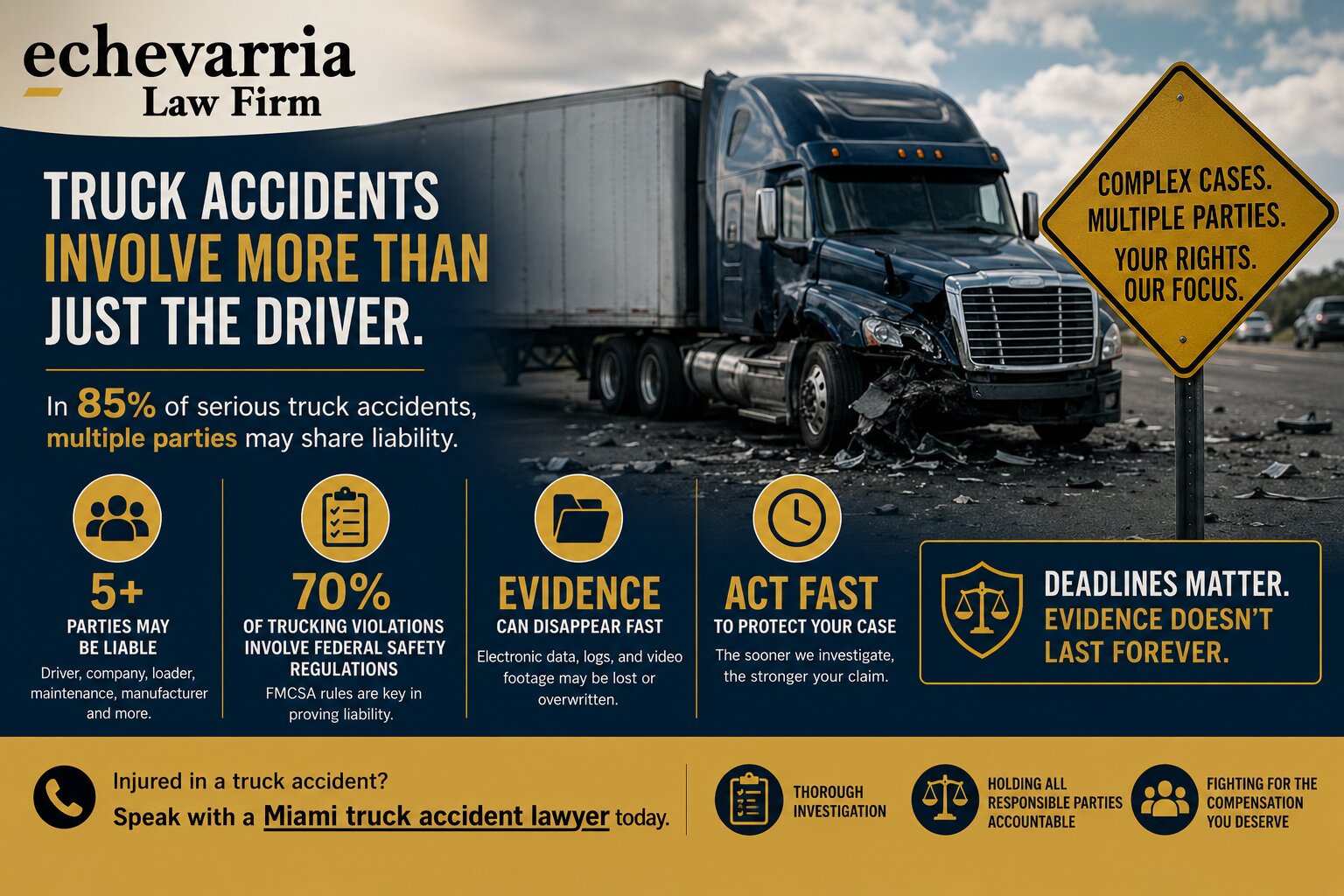
One of the defining characteristics of commercial trucking litigation is the number of potentially responsible parties.
Unlike an ordinary automobile accident, a commercial shipment often involves several businesses working together.
Examples include:
- The trucking company
- The truck driver
- The trailer owner
- The freight broker
- The cargo loading company
- Maintenance providers
- Vehicle manufacturers
- Parts suppliers
Each company may have separate insurance coverage and separate legal responsibilities.
That is why determining liability often requires significantly more investigation than a standard automobile collision.
Federal FMCSA Rules That Expand Liability
Commercial trucking companies must comply with safety regulations established by the Federal Motor Carrier Safety Administration (FMCSA).
These regulations are designed to reduce accidents by establishing nationwide safety standards.
Violations of these rules may become important evidence during a truck accident investigation.
Hours of Service Regulations
Driver fatigue remains one of the leading causes of commercial truck accidents.
FMCSA Hours of Service rules limit:
- Daily driving time
- Weekly driving hours
- Mandatory rest periods
- Required off-duty time
If investigators discover that a driver exceeded these limits or a trucking company knowingly encouraged violations, those facts may become relevant in determining liability.
Driver Qualification Standards
Commercial drivers must satisfy federal qualification requirements before operating large commercial vehicles.
These requirements include:
- Valid commercial driver’s licenses (CDLs)
- Medical certification
- Safe driving history
- Driver qualification files
- Ongoing compliance reviews
If a company hired an unqualified driver or failed to properly screen applicants, that decision may contribute to liability.
Inspection and Maintenance Requirements
Federal regulations require commercial carriers to inspect and maintain their vehicles regularly.
Important documents include:
- Daily vehicle inspection reports
- Annual inspection records
- Brake inspections
- Tire maintenance records
- Repair invoices
- Maintenance schedules
Incomplete or missing maintenance records may indicate that required inspections were not properly performed.
Cargo Securement Standards
Federal cargo securement regulations establish how freight must be loaded and secured.
Improper cargo securement may increase the likelihood of:
- Cargo shifts
- Rollovers
- Falling debris
- Jackknife crashes
- Loss of vehicle control
Cargo manifests and loading records often become important evidence in determining whether loading procedures complied with federal standards.
The Evidence That Proves Liability in Truck Cases
Truck accident investigations frequently involve much more documentation than ordinary automobile accidents.
Commercial carriers generate extensive operational records that may provide insight into what happened before the collision.
Driver Logs
Driver logs document:
- Driving hours
- Rest breaks
- Duty status
- Work schedules
These records may help determine whether fatigue contributed to the crash.
Electronic Logging Devices (ELDs)
Most commercial vehicles use Electronic Logging Devices that automatically record driving activity.
These records may verify:
- Driving time
- Vehicle movement
- Rest periods
- Route history
ELD data often helps investigators compare actual driving activity with reported work schedules.
Black Box (ECM) Data
Many commercial trucks contain Event Data Recorders or Electronic Control Modules.
These systems may record:
- Speed
- Brake application
- Engine RPM
- Throttle position
- Cruise control usage
- Sudden braking
- Collision timing
This information often helps accident reconstruction experts understand what occurred immediately before impact.
Maintenance Records
Maintenance documentation may reveal:
- Missed inspections
- Repeated repair issues
- Safety violations
- Mechanical defects
- Delayed repairs
These records can establish whether preventable equipment failures contributed to the accident.
Cargo Manifests
Cargo records identify:
- Freight weight
- Cargo distribution
- Loading locations
- Responsible loading companies
- Hazardous materials
When cargo shifts or overloading is suspected, these documents become especially important.
Driver Qualification Files
Federal regulations require trucking companies to maintain detailed qualification files for commercial drivers.
These files may include:
- Employment applications
- Driving records
- Medical certifications
- Training history
- Drug and alcohol testing records
- Safety violations
Reviewing these records may reveal whether the driver met federal requirements.
Additional Evidence
Other evidence commonly reviewed includes:
- Police crash reports
- Dash camera footage
- Traffic camera video
- Cell phone records
- Witness statements
- Photographs
- Accident reconstruction reports
- GPS tracking data
- Dispatch communications
No single piece of evidence usually tells the entire story.
Instead, investigators analyze multiple sources to determine how the collision occurred.
Why Acting Fast Matters
Time is one of the most important factors after a commercial truck accident.
Certain evidence may not remain available indefinitely.
Electronic data can be overwritten.
Surveillance footage may be deleted.
Vehicles may be repaired.
Maintenance records may change.
Witnesses may become difficult to locate.
Memories naturally fade.
Beginning an investigation early may help preserve valuable evidence before it disappears.
Prompt legal involvement may also allow steps to be taken to request preservation of electronic records and other documents that could become important later.
Why Legal Representation Can Make a Difference
Truck accident claims often involve multiple insurance companies, corporate legal teams, and extensive technical evidence.
Unlike a standard automobile accident, these cases frequently require reviewing federal regulations, commercial maintenance records, electronic driving data, employment records, and company safety practices.
Determining who should be held responsible often requires identifying every party that contributed to the accident—not simply the truck driver.
If you’ve been injured in a commercial truck accident, understanding the legal issues involved is an important first step. Speaking with a Miami truck accident lawyer or call us at 305.707.3991 through the firm’s Truck Accidents can help you better understand your legal rights, the evidence that may be relevant to your case, and the options available under Florida law.
Frequently Asked Questions
Who pays for damages in a truck accident?
The person or company found legally responsible for causing the accident may be required to pay damages. Depending on the circumstances, liability may extend to the truck driver, trucking company, cargo loader, maintenance contractor, vehicle manufacturer, or multiple parties.
Can you sue the trucking company directly?
In some cases, yes. If the trucking company’s own actions contributed to the accident—such as negligent hiring, inadequate training, poor maintenance, or violations of federal safety regulations—it may be possible to pursue a claim against the company.
What evidence do you need in a truck accident case?
Important evidence may include driver logs, Electronic Logging Device (ELD) data, black box (ECM) information, maintenance records, inspection reports, cargo manifests, driver qualification files, police reports, photographs, witness statements, and accident reconstruction reports.
Why are truck accident cases more complicated than regular car accidents?
Truck accident cases often involve multiple companies, federal safety regulations, commercial insurance policies, maintenance records, cargo handling procedures, and technical evidence. As a result, determining liability typically requires a more extensive investigation.
What are FMCSA regulations?
The Federal Motor Carrier Safety Administration (FMCSA) establishes nationwide safety rules governing commercial trucking. These regulations address driver qualifications, Hours of Service limits, vehicle inspections, maintenance requirements, and cargo securement. Violations may become important evidence in determining liability.
How long is trucking evidence preserved?
Some evidence, such as electronic data or surveillance footage, may only be retained for a limited period. Because retention policies vary, acting promptly after an accident can be important to help preserve relevant information.
Can more than one party be responsible for a truck accident?
Yes. Many truck accident claims involve multiple responsible parties. Depending on the circumstances, liability may be shared among the truck driver, trucking company, cargo loading company, maintenance contractor, manufacturer, or others involved in the transportation process.
Disclaimer
This article is for general informational purposes only and does not constitute legal advice. For advice specific to your situation, contact a licensed Florida personal injury attorney.